
and Killer List of Videogames® at Museum of the Game® | Sign In Register |
- Collections
- Shops
Ninja Baseball Batman (US) Games-db.com is the ultimate Game Database, your one-stop source for games of all genres and types. From the old 8-bit computer games. (Arcade) Ninja Baseball Batman, completed 1 Credit - 1cc (1-Sissy? Recorded in WolfMAME.0168 on my.
- Help Out
- About
- Titles
- Types
- Companies
- Flyers
- Magazines
- Auctions
- History
- Articles
- More
- Search
Ninja Baseball Bat Man
| Please be sure to check out the Museum of the Game's and Arcadia's new 2-minute creative video: Arcadia - 100 Years of Gaming History |
| Name: Ninja Baseball Bat Man Manufacturer: Irem Year: 1993 Type: Videogame Class: Wide Release
Number of Simultaneous Players: 2
Sound: Amplified Mono (one channel) Cabinet Styles:
|
Ninja Baseball Bat Man DescriptionNinja Baseball Bat Man was produced by Irem in 1993. Irem released 87 different machines in our database under this trade name, starting in 1978. Other machines made by Irem during the time period Ninja Baseball Bat Man was produced include In The Hunt, Hill Climber, Kaitei Daisensou, Risky Challenge - Escape from Dungeons, Fire Barrel, Dynablaster Global Conquest, Hook, Bomber Man World, Quiz F1 1,2 Finish, and Mahou Keibitai Ganhooki. Ninja Baseball Bat Man - KLOV/IAM 5 Point User Score: 4.40 (1 vote)
Personal Impressions and Technical Impressions each account for half of the total score. Within the Personal Impressions category, 'Like' carries a little more weight than the other factors. Log in to rate this game! Cabinet Style Weights and Measures
VAPS Arcade/Coin-Op Ninja Baseball Bat Man CensusThere are 10,975 members of the Video Arcade Preservation Society / Vintage Arcade Preservation Society, 8,801 whom participate in our arcade census project of games owned, wanted, or for sale. Census data currently includes 147,135 machines (6,416 unique titles).Common - There are 40 known instances of this machine owned by Ninja Baseball Bat Man collectors who are active members. Of these, 2 of them are conversions in which game circuit boards (and possibly cabinet graphics) have been placed in (and on) another game cabinet, and 38 of them are only circuit boards which a collector could put into a generic case if desired. For Sale - There is one active VAPS member with an extra Ninja Baseball Bat Man circuit board for sale. Wanted - There are 2 active VAPS members currently looking for Ninja Baseball Bat Man. There are 7 active VAPS members looking for Ninja Baseball Bat Man board sets. This game ranks a 5 on a scale out of 100 (100 = most often seen, 1=least common) in popularity based on census ownership records. This game ranks a 15 on a scale out of 100 (100 = most often wanted, 1=least common) in popularity based on census want list records.
Manuals
See Recent Video Links Added to Other Records
Contribute
eBay ListingsClick to search eBay for Ninja Baseball Bat Man Videogame machines and related items.Click to search eBay for machines and parts made by Irem. Eastside hockey manager 2020. Check out the IAM/KLOV report of the hottest coin-op machine auctions, powered by Ace.com. | Click here to contribute another image. |
| Ninja Baseball Bat Man | |
|---|---|
European arcade flyer of Ninja Baseball Bat Man. Hammerin' Harry is seen on the upper-left, while Undercover Cops and R-Type III: The Third Lightning are advertised on the blimps. | |
| Developer(s) | Irem Corporation(program) Irem America (concept) |
| Publisher(s) | Irem Corporation Irem America |
| Designer(s) | Drew Maniscalco (concept)[1] |
| Platform(s) | Arcade |
| Release | September 1993 |
| Genre(s) | Beat 'em up |
| Mode(s) | Up to 4 players simultaneously[2] |
| Cabinet | Upright |
| Display | Raster, standard resolution |
Ninja Baseball Bat Man, known in Japan as Yakyū Kakutō League Man (野球格闘リーグマン, Yakyū Kakutō Rīgu Man, 'Baseball Hand-to-Hand Fighting League Man'), is a 1993beat 'em up developed and published by Irem Corporation (now known as Irem Software Engineering) in association with its North American division Irem America exclusively as an arcade game. It is the fourth arcade game by IREM to use a belt scroll perspective, following Blade Master, Hook and Undercover Cops.
Gameplay[edit]
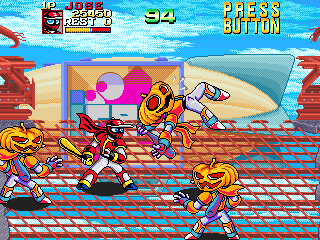
The game allows up to four players to play simultaneously. Each player chooses from among four characters. The object of the game is to recover various artifacts stolen from the Baseball Hall of Fame, a task prescribed to them by the Commissioner of Baseball. Each stage takes place in several parts of the United States, while a boss character will appear at the end of each stage, which requires the player(s) to defeat it. Like in most arcade video games, whether the player fails or beats the game, he or she will type in three letters or other text characters in to record their score.
Like Irem's previous beat 'em up arcade Undercover Cops, Ninja Baseball Bat Man features playable characters with several different fighting moves performed by inputting several commands using an 8-way joystick and two buttons (attack and jump), including 'smart bomb' or 'screen zapper' moves that sacrifices health in order to annihilate every enemy on the screen. The game also allows players to perform combos, throws and dash attacks against several enemies. When a player's health bar flashes red, more moves can be performed as long as the player does not restore or completely lose health. There are items throughout the game that include American and Japanese food for restoring health, alternate weapons such as baseballs and shurikens, or items that call cheerleaders to either obliterate enemies on screen or drop a large amount of food. There are also mini-games after each boss before the final one is defeated.
Characters[edit]
- Captain Jose (6'1', 174 lbs), known in Japan as Captain Red - The head of the team and a 'technician'. He is well-balanced, making him the best choice for beginners. His hat has a letter 'I'.
- Twinbats Ryno (5'7', 145 lbs), known in Japan as Twinbats Green - He is a 'speedy attacker' that wields two bats, but is the weakest of the four. His hat has a letter 'R'.
- Beanball Roger (5'9', 240 lbs), known in Japan as Beanball Yellow - He is a 'powerful buster', but not as fast as others. His hat has a letter 'E'.
- Stick Straw (7'2', 194 lbs), known in Japan as Stick Blue - He is a 'long-reach hitter', making him the best choice for players who want to fight with long-range moves. His hat has a letter 'M'.
Development[edit]
Irem America opened its U.S. office in 1988 in Redmond, Washington, headed up by Frank Ballouz (founder of Fabtek, a thriving video kit company and former North American publisher of several arcades by Seibu Kaihatsu and TAD Corporation) and National Sales Manager Drew Maniscalco. During this time, Drew created the 'Ninja Baseball Bat Man' video game concept (including the English title, plot and characters) and licensed it to Irem America in 1991.[1] To illustrate the characters' sketches, Drew hired Gottlieb's well-known pinball artist, Gordon Morison.[3]
Drew's concept came up after he read the top-grossing films during its time in a USA Today newspaper. One was Teenage Mutant Ninja Turtles; the other was one of the Batman films (possibly Batman Returns). After that, he started creating his own superhero influenced by what he saw in the USA Today newspaper. During the development of his concept, he liked the word ninja, because of it sounding mysterious to him. He gave the protagonists baseball bats and baseballs as their main weapons, as well as dressing them in baseball uniforms, because Drew is a baseball fan. Drew thought the baseball bat idea was also probably an influence from the 1973 film Walking Tall. This was also how he came up with the game's English title. In Japan, however, Irem of Japan's staff came up with the game's Japanese name as a reference to numerous tokusatsu television shows, most notably the Super Sentai series. Drew later created the concept for the other characters such as enemies.[3] To illustrate the characters' sketches, Drew hired Gottlieb's well-known pinball artist, Gordon Morison.[3]
Drew's original gameplay ideas for the video game was for a 1-player, adventure-based, platform game similar to Nintendo's Super Mario Bros. However, due to the very successful game sales of several 4-player games (most of them being beat 'em ups), Drew added 3-players in an effort to compete with the 4-player games. While the title and characters were Drew's concept, Irem Japan programmed the arcade game, and modified the look of its prototype. Drew did not mind it being different, as he was thrilled about it being programmed by them.[4]
During the development of the two-player platform version, the two main characters were named 'Willie' and 'Mickey', named after Drew's two favorite baseball players of his childhood, Willie Mays and Mickey Mantle.[5] During the development of the 4-player beat 'em up version, the prototype names of the four main characters were Captain Jeff (red), Nunchaks Sugar (green), Hammer' Eddy (yellow) and Naginata Jimmy (blue).[6] Drew later came up with the final names of the four protagonists that are currently used in the finished version today, which the names are references to the four baseball stars during the arcade game's release: Jose Canseco (red), Ryne Sandberg (green), Roger Clemens (yellow) and Darryl Strawberry (blue).[5] In Japan, their last names were changed to the names of their colors.
A year after its concept was created and a year before it was released, despite it being interesting in his opinion, Drew left the company in 1992 and moved to Data East USA. Because of that, he was unable to market nor manage any other input related to the game. However, according to his interview with Gameroom magazine, he now owns the rights to Ninja Baseball Bat Man's non-video game products, while Irem Japan owns the rights to its video game content.[7]
Reception and related releases[edit]
During its release in 1993, despite being one of the top arcade hits of Japan while receiving good reviews from critics,[5][8] when compared to the sales of other kits sold at the time, it sold poorly in the Far East and especially North America. Of the 1042 units sold, only 43 units were sold in North America, making Ninja Baseball Bat Man quite rare (especially in the U.S.). Drew 'was very disappointed with the effort by the US office.'[5] Despite all of this, the popularity of the arcade emulator MAME caused Ninja Baseball Bat Man to gain more popularity years later than it had when originally released.[9]
The arcade flyers for Ninja Baseball Bat Man has advertisements for Irem's three other video games and franchises: Hammerin' Harry, Undercover Cops and R-Type III: The Third Lightning. An advertisement poster for Mahou Keibitai Gun Hoki (known as Mystic Riders outside of Japan), another arcade game by Irem, appears in the first stage of Ninja Baseball Bat Man.
References[edit]
- ^ abGameroom magazine. 22: 19–21. September 2010.Missing or empty
title=(help) - ^'Game profile at MAWS'. Archived from the original on 2011-08-20. Retrieved 2009-05-07.
- ^ abcGameroom magazine. 22: 20–21. September 2010.Missing or empty
title=(help) - ^Gameroom magazine. 22: 21–22. September 2010.Missing or empty
title=(help) - ^ abcdGameroom magazine. 22: 22. September 2010.Missing or empty
title=(help) - ^Gameroom magazine. 22: 20. September 2010.Missing or empty
title=(help) - ^Gameroom magazine. 22: 22–23. September 2010.Missing or empty
title=(help) - ^Game Machine Magazine. January 1, 1994.Missing or empty
title=(help) - ^Gameroom magazine. 22: 23. September 2010.Missing or empty
title=(help)
External links[edit]
- Ninja Baseball Bat Man at MAWS
- Ninja Baseball Bat Man at the Killer List of Videogames
- Ninja Baseball Bat Man at MobyGames
- Author: admin
- Category: Category
and Killer List of Videogames® at Museum of the Game® | Sign In Register |
- Collections
- Shops
Ninja Baseball Batman (US) Games-db.com is the ultimate Game Database, your one-stop source for games of all genres and types. From the old 8-bit computer games. (Arcade) Ninja Baseball Batman, completed 1 Credit - 1cc (1-Sissy? Recorded in WolfMAME.0168 on my.
- Help Out
- About
- Titles
- Types
- Companies
- Flyers
- Magazines
- Auctions
- History
- Articles
- More
- Search
Ninja Baseball Bat Man
| Please be sure to check out the Museum of the Game's and Arcadia's new 2-minute creative video: Arcadia - 100 Years of Gaming History |
| Name: Ninja Baseball Bat Man Manufacturer: Irem Year: 1993 Type: Videogame Class: Wide Release
Number of Simultaneous Players: 2
Sound: Amplified Mono (one channel) Cabinet Styles:
|
Ninja Baseball Bat Man DescriptionNinja Baseball Bat Man was produced by Irem in 1993. Irem released 87 different machines in our database under this trade name, starting in 1978. Other machines made by Irem during the time period Ninja Baseball Bat Man was produced include In The Hunt, Hill Climber, Kaitei Daisensou, Risky Challenge - Escape from Dungeons, Fire Barrel, Dynablaster Global Conquest, Hook, Bomber Man World, Quiz F1 1,2 Finish, and Mahou Keibitai Ganhooki. Ninja Baseball Bat Man - KLOV/IAM 5 Point User Score: 4.40 (1 vote)
Personal Impressions and Technical Impressions each account for half of the total score. Within the Personal Impressions category, 'Like' carries a little more weight than the other factors. Log in to rate this game! Cabinet Style Weights and Measures
VAPS Arcade/Coin-Op Ninja Baseball Bat Man CensusThere are 10,975 members of the Video Arcade Preservation Society / Vintage Arcade Preservation Society, 8,801 whom participate in our arcade census project of games owned, wanted, or for sale. Census data currently includes 147,135 machines (6,416 unique titles).Common - There are 40 known instances of this machine owned by Ninja Baseball Bat Man collectors who are active members. Of these, 2 of them are conversions in which game circuit boards (and possibly cabinet graphics) have been placed in (and on) another game cabinet, and 38 of them are only circuit boards which a collector could put into a generic case if desired. For Sale - There is one active VAPS member with an extra Ninja Baseball Bat Man circuit board for sale. Wanted - There are 2 active VAPS members currently looking for Ninja Baseball Bat Man. There are 7 active VAPS members looking for Ninja Baseball Bat Man board sets. This game ranks a 5 on a scale out of 100 (100 = most often seen, 1=least common) in popularity based on census ownership records. This game ranks a 15 on a scale out of 100 (100 = most often wanted, 1=least common) in popularity based on census want list records.
Manuals
See Recent Video Links Added to Other Records
Contribute
eBay ListingsClick to search eBay for Ninja Baseball Bat Man Videogame machines and related items.Click to search eBay for machines and parts made by Irem. Eastside hockey manager 2020. Check out the IAM/KLOV report of the hottest coin-op machine auctions, powered by Ace.com. | Click here to contribute another image. |
| Ninja Baseball Bat Man | |
|---|---|
European arcade flyer of Ninja Baseball Bat Man. Hammerin' Harry is seen on the upper-left, while Undercover Cops and R-Type III: The Third Lightning are advertised on the blimps. | |
| Developer(s) | Irem Corporation(program) Irem America (concept) |
| Publisher(s) | Irem Corporation Irem America |
| Designer(s) | Drew Maniscalco (concept)[1] |
| Platform(s) | Arcade |
| Release | September 1993 |
| Genre(s) | Beat 'em up |
| Mode(s) | Up to 4 players simultaneously[2] |
| Cabinet | Upright |
| Display | Raster, standard resolution |
Ninja Baseball Bat Man, known in Japan as Yakyū Kakutō League Man (野球格闘リーグマン, Yakyū Kakutō Rīgu Man, 'Baseball Hand-to-Hand Fighting League Man'), is a 1993beat 'em up developed and published by Irem Corporation (now known as Irem Software Engineering) in association with its North American division Irem America exclusively as an arcade game. It is the fourth arcade game by IREM to use a belt scroll perspective, following Blade Master, Hook and Undercover Cops.
Gameplay[edit]
The game allows up to four players to play simultaneously. Each player chooses from among four characters. The object of the game is to recover various artifacts stolen from the Baseball Hall of Fame, a task prescribed to them by the Commissioner of Baseball. Each stage takes place in several parts of the United States, while a boss character will appear at the end of each stage, which requires the player(s) to defeat it. Like in most arcade video games, whether the player fails or beats the game, he or she will type in three letters or other text characters in to record their score.
Like Irem's previous beat 'em up arcade Undercover Cops, Ninja Baseball Bat Man features playable characters with several different fighting moves performed by inputting several commands using an 8-way joystick and two buttons (attack and jump), including 'smart bomb' or 'screen zapper' moves that sacrifices health in order to annihilate every enemy on the screen. The game also allows players to perform combos, throws and dash attacks against several enemies. When a player's health bar flashes red, more moves can be performed as long as the player does not restore or completely lose health. There are items throughout the game that include American and Japanese food for restoring health, alternate weapons such as baseballs and shurikens, or items that call cheerleaders to either obliterate enemies on screen or drop a large amount of food. There are also mini-games after each boss before the final one is defeated.
Characters[edit]
- Captain Jose (6'1', 174 lbs), known in Japan as Captain Red - The head of the team and a 'technician'. He is well-balanced, making him the best choice for beginners. His hat has a letter 'I'.
- Twinbats Ryno (5'7', 145 lbs), known in Japan as Twinbats Green - He is a 'speedy attacker' that wields two bats, but is the weakest of the four. His hat has a letter 'R'.
- Beanball Roger (5'9', 240 lbs), known in Japan as Beanball Yellow - He is a 'powerful buster', but not as fast as others. His hat has a letter 'E'.
- Stick Straw (7'2', 194 lbs), known in Japan as Stick Blue - He is a 'long-reach hitter', making him the best choice for players who want to fight with long-range moves. His hat has a letter 'M'.
Development[edit]
Irem America opened its U.S. office in 1988 in Redmond, Washington, headed up by Frank Ballouz (founder of Fabtek, a thriving video kit company and former North American publisher of several arcades by Seibu Kaihatsu and TAD Corporation) and National Sales Manager Drew Maniscalco. During this time, Drew created the 'Ninja Baseball Bat Man' video game concept (including the English title, plot and characters) and licensed it to Irem America in 1991.[1] To illustrate the characters' sketches, Drew hired Gottlieb's well-known pinball artist, Gordon Morison.[3]
Drew's concept came up after he read the top-grossing films during its time in a USA Today newspaper. One was Teenage Mutant Ninja Turtles; the other was one of the Batman films (possibly Batman Returns). After that, he started creating his own superhero influenced by what he saw in the USA Today newspaper. During the development of his concept, he liked the word ninja, because of it sounding mysterious to him. He gave the protagonists baseball bats and baseballs as their main weapons, as well as dressing them in baseball uniforms, because Drew is a baseball fan. Drew thought the baseball bat idea was also probably an influence from the 1973 film Walking Tall. This was also how he came up with the game's English title. In Japan, however, Irem of Japan's staff came up with the game's Japanese name as a reference to numerous tokusatsu television shows, most notably the Super Sentai series. Drew later created the concept for the other characters such as enemies.[3] To illustrate the characters' sketches, Drew hired Gottlieb's well-known pinball artist, Gordon Morison.[3]
Drew's original gameplay ideas for the video game was for a 1-player, adventure-based, platform game similar to Nintendo's Super Mario Bros. However, due to the very successful game sales of several 4-player games (most of them being beat 'em ups), Drew added 3-players in an effort to compete with the 4-player games. While the title and characters were Drew's concept, Irem Japan programmed the arcade game, and modified the look of its prototype. Drew did not mind it being different, as he was thrilled about it being programmed by them.[4]
During the development of the two-player platform version, the two main characters were named 'Willie' and 'Mickey', named after Drew's two favorite baseball players of his childhood, Willie Mays and Mickey Mantle.[5] During the development of the 4-player beat 'em up version, the prototype names of the four main characters were Captain Jeff (red), Nunchaks Sugar (green), Hammer' Eddy (yellow) and Naginata Jimmy (blue).[6] Drew later came up with the final names of the four protagonists that are currently used in the finished version today, which the names are references to the four baseball stars during the arcade game's release: Jose Canseco (red), Ryne Sandberg (green), Roger Clemens (yellow) and Darryl Strawberry (blue).[5] In Japan, their last names were changed to the names of their colors.
A year after its concept was created and a year before it was released, despite it being interesting in his opinion, Drew left the company in 1992 and moved to Data East USA. Because of that, he was unable to market nor manage any other input related to the game. However, according to his interview with Gameroom magazine, he now owns the rights to Ninja Baseball Bat Man's non-video game products, while Irem Japan owns the rights to its video game content.[7]
Reception and related releases[edit]
During its release in 1993, despite being one of the top arcade hits of Japan while receiving good reviews from critics,[5][8] when compared to the sales of other kits sold at the time, it sold poorly in the Far East and especially North America. Of the 1042 units sold, only 43 units were sold in North America, making Ninja Baseball Bat Man quite rare (especially in the U.S.). Drew 'was very disappointed with the effort by the US office.'[5] Despite all of this, the popularity of the arcade emulator MAME caused Ninja Baseball Bat Man to gain more popularity years later than it had when originally released.[9]
The arcade flyers for Ninja Baseball Bat Man has advertisements for Irem's three other video games and franchises: Hammerin' Harry, Undercover Cops and R-Type III: The Third Lightning. An advertisement poster for Mahou Keibitai Gun Hoki (known as Mystic Riders outside of Japan), another arcade game by Irem, appears in the first stage of Ninja Baseball Bat Man.
References[edit]
- ^ abGameroom magazine. 22: 19–21. September 2010.Missing or empty
title=(help) - ^'Game profile at MAWS'. Archived from the original on 2011-08-20. Retrieved 2009-05-07.
- ^ abcGameroom magazine. 22: 20–21. September 2010.Missing or empty
title=(help) - ^Gameroom magazine. 22: 21–22. September 2010.Missing or empty
title=(help) - ^ abcdGameroom magazine. 22: 22. September 2010.Missing or empty
title=(help) - ^Gameroom magazine. 22: 20. September 2010.Missing or empty
title=(help) - ^Gameroom magazine. 22: 22–23. September 2010.Missing or empty
title=(help) - ^Game Machine Magazine. January 1, 1994.Missing or empty
title=(help) - ^Gameroom magazine. 22: 23. September 2010.Missing or empty
title=(help)
External links[edit]
- Ninja Baseball Bat Man at MAWS
- Ninja Baseball Bat Man at the Killer List of Videogames
- Ninja Baseball Bat Man at MobyGames