

| Dragonica | |
|---|---|
| Basic Information | |
| Video Game | |
| Action, FantasyMMORPG | |
| Download | |
| USB Game Pad, Keyboard, Mouse (non-gameplay)[1] | |
| Windows 2000, Windows XP and Windows Vista[2] | |
| Technical Information | |
| Various stages | |
| Awards Changelog Cheats Codes Codex Compatibility Covers Credits DLC Help Localization Manifest Modding Patches Ratings Reviews Screenshots Soundtrack Videos Walkthrough | |
Don't forget to get those Costume Inventory Expansion items while they are on sale in the Dragon Saga Item Mall! Which favored costumes do you have in your Costume Inventory?
Dragonica Online is a 3D action side-scrollingMMORPG (massively multiplayer online role-playing game) developed by Barunson Interactive. Development has been ongoing since March 2006.[2] Operation of Dragonica is relegated to different publishers for their respective regions. It is a free-to-play game which includes a cash shop that allows for unique customization of player's characters.[4] The game has been in Open Beta across Europe since June 10, 2009[5], has implemented the Kundara Content Update during August 2009[6] and has announced that the 'Tales of the Damned' expansion will be introduced during October 2009[7]. The North American Open Beta Test began on August 18, 2009.[8] Characters created during the Open Beta Test will carry over to the commercial release.[9]
Gameplay[editedit source]
Players control a character in a three-dimensional plane but the scope of movement is mainly focused on the horizontal axis with limited vertical movement, much like the arcade style side-scrolling classics. In its current state, players can progress through 65 levels in the North American release with the level cap reaching as high as 80 on servers in Asia.
Combat is action-based with moves performed in real-time. All combat is centered around the use of special skill sets on cooldowns. Players can also perform ground and aerial combos by utilizing certain skills in order to render enemies unable to retaliate but can also play the role of a healer or supporter when necessary.
There is also a large number of missions and scenarios for a player to complete co-operatively with others. Each individual dungeon has one to four separate modes for advancement, each increasing in difficulty and not being accessible until the previous instance has been cleared. At the end of every mission sequence is a scenario that advances your character to the next stage of the game.
Classes[editedit source]
At the beginning of the game, players are allowed to choose from one of four basic classes and accumulate levels in order to advance into deeper specialties with more abilities and skills. Classes include the warrior, thief, archer, and the magician. Each class has a diverse skill tree in which players may place points into to acquire new skills or enhance ones that have already been obtained.
The warrior is a melee-oriented class which focuses mainly on performing various air combos and ground techniques to keep enemies immobilized and weakened. In groups the warrior assumes the role of a 'tank' though not in the conventional sense; the warrior is in charge of keeping enemies from reaching the mid-lines where the healers and ranged classes are ideally situated. Against bosses the warrior will often bear the brunt of the attacks due to the lack of ranged attacks. The warrior class can advance to become either a gladiator or knight.
The thief class employs swift attacks and combos to annihilate waves of enemies. Focused around the use of claws, the thief is often seen on the frontlines alongside the warriors dealing damage and debuffing enemies at will. In group situations, the thief makes use of attacking from behind the enemy in order to increase the ranking score on mission maps. They specialize in and speed to tear down lines of enemies as quickly as possible. Oftentimes they are utilized as 'cleaners' or 'sweepers' in missions to pick up any enemies the frontline may have missed. The thief class can advance to become either a jester or assassin.
The archer class wields bows, crossbows, and even gatling guns to lay waste to any enemies from afar. They are seen mainly in the mid-line in-between the healers and the melee classes. They capitalize on wreaking havoc on enemies by spamming one button to keep the enemy in midair to obtain as high of a ranking as possible in groups. Although their attack power is weaker than that of a warrior's, their attack speed and movement speed is among the fastest in the game. Archers can advance to become either a pathfinder or a arbalist.
The magician is the game's token caster class. Seen very often in the frontlines, the magician is occupied with either healing and buffing the group or dealing massive amounts of area of effect damage to enemies. In groups the magician becomes one of the most valuable assets as they are able to heal the wounds of damaged allies and offer support from a distance, without ever getting caught up in the action itself. Magicians can advance to become either an monk or a battlemage.
Missions[editedit source]
Dragonica features instances that allow players to gain access to items, experience, and currency as well as serve to advance the overall storyline in the game. These instances are known as 'missions' and must be completed sequentially in order to unlock the final scenario that advances the plot. Each step in the mission becomes significantly more difficult than the previous and oftentimes requires a group to complete.
Missions are often composed of four main mission modes (increasing in difficulty) and a fifth scenario (unlocked when the previous modes have been completed). Each step in the mission also features a grading system that attempts to rank players based on how a player has performed during that step. The grading system allows the player to obtain higher quality and quantity loot based on that individual's performance and group contribution.
Players will often be sent into these missions to complete important quests. Although many of these missions can be done by oneself, the benefits of tackling these missions with others far outweigh that of taking them on alone. Players in groups gain bonus experience and, with the right group composition, will find it much easier to progress through the game.
I'll say it again: I'm NOT a troll, and what I just said is NOT a joke. I played the game for at least two hours or so and for some reason, other than the bad camera and occasionally messed-up A.I., but other than that, I just can't find any other problems with the game. Drake of the 99 dragons amazon. I never got stuck in a glitch, the voice acting is actually not too bad, and the fact that Drake (the main character) moves fast is something that I've actually found as a cool feature to the game.
Cash Shop[editedit source]
Cash shop equipments may be soulcrafted and enchanted to increase the stats and defense of the player. Items range from changing your character's standard hairdos to seasonal costumes and attire. Several items from the cash shop include Enchantment Insurance to eliminate the possibility of a loss when enhancing or soulcrafting a character's equipment, or Experience Potions which allow for a character to receive an increase in experience received for the duration in which it is used. More recently, several cash shop items have been included which offer an assortment of random items much like the treasure chests found in Atlantica Online.
Development[editedit source]
ICEE's Chinese Dragonica released their and no but yes Version 6 Open Beta on April 24, 2009.[10] Publisher of the North American version, THQ*ICE, has started the official service on October 15, 2009. As of August 31st, THQ*ICE will be shutting down their services and Gravity Interactive will continue North American publishing in late September.[11]
IAH and 8interactive's Dragonica for the SEA-ANZ region is currently in Open Beta.[12]gPotato Europe's EU English, French and German services began on June 10, 2009.[13]
| Region | Language(s) | Publisher | Alpha | Alpha #2 | Pre-CBT | CBT | OBT | Full Release |
|---|---|---|---|---|---|---|---|---|
| China | Simplified Chinese | ICE Entertainment[14] | March 19–27, 2008[15] | July 2008 | November 6, 2008[16] | February 26, 2009[17] | ||
| Southeast Asia, Australia, New Zealand | English, Simplified Chinese | IAHgames[18] / 8interactive[19] | June 14–15, 2008[20] | July 24–28, 2008[4] | February 13–14 & 20-21, 2009[21] | May 7–18, 2009[12] | June 4, 2009[22] | |
| Taiwan, Hong Kong, Macau | Traditional Chinese | GameFlier[23] | May 25, 2009[24] | |||||
| Europe | English, French, German | gPotato Europe[25] | May 13–22, 2009[26] | June 10, 2009[27] | October 15, 2009[28] | |||
| North America | English | THQ*ICE[29] Gravity Interactive, Inc. (As of August 31, 2010)[30] | March 30 - April 1, 2009 | May 29, 2009[31] | June 30, 2009[32] - July 14, 2009 | August 5, 2009 | October 15, 2009[33] | |
| Korea | Korean | PlayNC[34] | April 17–23, 2008[35] | September 1, 2010 | ||||
| Thailand | Thai | ONENET[36] | December 1–8, 2009 [37] | December 23, 2009 [38] | December 23, 2009 [39] | |||
| Russia | Russian | Nival Group[40] | December 11–21, 2009 [41][42] | December 24, 2009 [43] | ||||
| Japan | Japanese | Nexon Japan[44] | December 23–28, 2009 [45] | January 6, 2010 [46] | January 20, 2010 [47] | |||
| Philippines | English | Egames[48] | December 2009 | April 1 - May 3, 2010 | July 19, 2010 [49] - August 18, 2010 | August 24, 2010 |
References[editedit source]
- ↑Superb quality and action, Dragonica. Barunson Interactive. Retrieved on 2009-04-24
- ↑ 2.02.12.2Dragonica Introduction Document. Barunson Interactive. Retrieved on 2009-04-24
- ↑System Requirements. Barunson Interactive. Retrieved on 2009-04-23
- ↑ 4.04.1Dragonica Interview with IAHGames. MMOsite.com. Retrieved on 2009-04-23
- ↑Dragonica enters open beta in Europe - Massively. Massively. Retrieved on 2009-09-16
- ↑Dragonica Europe: Kundara Dungeon and VanCliff Fortress. OnRPG. Retrieved on 2009-09-16
- ↑gPotato Europe announces the first expansion for Dragonica: Tales of the Damned. IGN. Retrieved on 2009-09-16
- ↑THQ*ICE Dragonica Online Open Beta Test Countdown Page. THQ*ICE. Retrieved on 2009-08-13
- ↑Information on Dragonica Online's Beta Test Phases. THQ*ICE. Retrieved on 2009-08-13
- ↑(Dream Dragon) Fire Shadow Version Open Beta today!. ICE Entertainment. Retrieved on 2009-04-24
- ↑Interview: Draconica THQ*ICE to Close. Barunson Interactive. Retrieved on 2010-8-10
- ↑ 12.012.1IMPORTANT: CBT Shift and Extension!. IAHGames. Retrieved on 2009-04-23
- ↑Dragonica goes on public release as Open Beta launches. gPotato Europe. Retrieved on 2009-06-20
- ↑http://ml.playcool.com/
- ↑Interview: ICEE Dragonica Marketing Manager on China CBT 1. CM Kaye. Retrieved on 2008-11-01
- ↑(China) Dragonica CBT launches on November 6. MMOsite.com. Retrieved on 2009-04-23
- ↑Dragonica enters Open Beta in China!. MMOsite.com. Retrieved on 2009-04-23
- ↑http://dragonica.iahgames.com
- ↑http://dragonica.8i.net.my/
- ↑LATEST UPDATE!!! Focus-Group Revival. CM Kaye. Retrieved on 2009-04-23
- ↑Fall In Love With Dragonica!. CM Kaye. Retrieved on 2009-04-23
- ↑8i Open Beta. 第八互动 梦龙传团队. Retrieved on 2009-05-30
- ↑http://ml.gameflier.com/
- ↑Closed Beta ends but Open Beta announced - May 25th -. gameflier.
- ↑http://dragonica.gpotato.eu/
- ↑- Dragonica Closed Beta Test 13th – 22nd of May -. gPotato Europe. Retrieved on 2009-05-08
- ↑- Closed Beta ends but Open Beta announced - June 10th -. gPotato Europe.
- ↑- Commercial Release - October 15th -. gPotato Europe.
- ↑http://dragonica.thqice.com/
- ↑http://forums.warpportal.com/index.php?/topic/2664-official-announcement-from-barunson-interactive/
- ↑http://dragonica-online.blogspot.com/2009/05/dragonica-online-preview-beta-test.html
- ↑http://dragonica.thqice.com/forum/viewthread.php?tid=1230&page=1
- ↑-Dragonica Online Grand Opening: October 15th. Retrieved on 2009-10-12
- ↑http://dragon.plaync.co.kr/
- ↑Dragonica proceeds Closed Beta Test on April 17. Barunson Interactive. Retrieved on 2009-04-23
- ↑- Dragonica Thailand.
- ↑- Thai Closed Beta.
- ↑- Thai Open Beta.
- ↑- Thai Official launch.
- ↑- Nival Group signs liecense for Russian dragonica.
- ↑- Russian Closed Beta Start.
- ↑- Russian Closed Beta end.
- ↑- Russian Open Beta Start.
- ↑- Dragonica Japan.
- ↑- Japanese Closed Beta.
- ↑- Japanese Open Beta.
- ↑- Japanese Official launch.
- ↑- Dragonica Ph.
- ↑- Ph Close Beta.
External links[editedit source]
- Dragonica Fan Wiki on Wiki.com
| Dragon Saga | |
|---|---|
| Developer(s) | Gravity Interactive[1] |
| Publisher(s) | gPotato Europe, GSquare, Nexon, Warpportal[2] |
| Engine | Gamebryo[3] |
| Platform(s) | Microsoft Windows |
| Release | Full list, see below |
| Genre(s) | Massively multiplayer online role-playing game |
| Mode(s) | Multiplayer |
Dragon Saga (Korean: 드래고니카) called Dragonica pre-2010, is a free-to-play3Dside-scrollingmassively multiplayer online role-playing game developed by Barunson Interactive and Gravity Interactive. Development has been ongoing since March 2006.[3] Operation of Dragon Saga is relegated to different publishers for their respective regions. Whilst being free-to-play, the game also includes a cash shop that allows for unique customization of player's characters.[4] The game's commercial launch was on June 2009 in China and October 2009 in Europe and October 2010 in North America.[5] Characters created during the Open Beta testing were carried over to the commercial release.[6]
Six content expansions for the game have been released, all of which are free: Tales of the Damned which was released on 16 October 2009[7] and Awakening of the Ice Dragon which was released on 15 February 2011[8] have both been released in North America.
Plot[edit]
Dragon Saga takes place on the continents of El Grego and Angrakka (Elyades and Melanthos in Europe), which had experienced a golden age where humans and dragons were able to live together in peace. These times were not destined to last, and the dragons and humans eventually went to war in what was known as the Dragon Age. Eventually, the dragons were banished to the ancient realm of Aether. The leader of the dragons, Dark Dragon Elga, would continue to mount attacks, but was pushed back when five heroes of legend defeated and trapped him in a prison known as the Shadow Cabinet.
Not even the Shadow Cabinet could hold Elga forever — a thousand years after being trapped, Elga found a method to release his darkness into the world, sending minions to attack the lands in preparation for his arrival. It is up the players to take up arms and push back these dark forces.[9][10]
Gameplay[edit]
Players control a character in a three-dimensional plane but the scope of movement is mainly focused on the horizontal axis with limited vertical movement, much like the arcade style side-scrolling classics. In its current state, players can progress through 75 levels in the North American release with the level cap reaching as high as 80 on servers in Asia.
Combat is action-based with moves performed in real-time. All combat is centered around the use of special skill sets on cooldowns. Players can also perform ground and aerial combos by utilizing certain skills in order to render enemies unable to retaliate but can also play the role of a healer or supporter when necessary.
There is also a large number of missions and scenarios for a player to complete co-operatively with others. Each individual dungeon has one to four separate modes for advancement, each increasing in difficulty and not being accessible until the previous instance has been cleared. At the end of every mission sequence is a scenario that advances your character to the next stage of the game.
Classes[edit]
At the beginning of the game, players are allowed to choose from one of six basic classes and accumulate levels in order to advance into deeper specialties with more abilities and skills. The six starting classes are warrior, thief, archer, magician, summoner, and twin fighter. Each class has a diverse skill tree in which players may place points into to acquire new skills or enhance ones that have already been obtained. As of 15 February 2011, there are currently a total of four class advancements in the game bringing the total number of playable classes to 28.
Tasks[edit]
Dragon Saga features instances that allow players to gain access to items, experience, and currency as well as serve to advance the overall storyline in the game. These instances are known as 'missions' and must be completed sequentially in order to unlock the final scenario that advances the plot. Each step in the mission becomes significantly more difficult than the previous and oftentimes requires a group to complete.
Missions are often composed of four main mission modes (increasing in difficulty) and a fifth scenario (unlocked when the previous modes have been completed). Each step in the mission also features a grading system that attempts to rank players based on how a player has performed during that step. The grading system allows the player to obtain higher quality and quantity loot based on that individual's performance and group contribution.
Players will often be sent into these missions to complete important quests, such as those needed to change class. Although many of these missions can be done by oneself, the benefits of tackling these missions with others far outweigh that of taking them on alone. Players in groups gain bonus experience and, with the right group composition, will find it much easier to progress through the game.
Expansions[edit]
Tales of the Damned (1)[edit]
Tales of the Damned was published on 16 October 2009 in Europe and November 2010 in North America. Tales of the Damned added a variety of new content and features to the game. This included the addition of a new storyline, controller support and the introduction of pets. The expansion elaborated into the story of the first chapter and as a result two new areas in Dragotaka were also introduced accessible to those who are level 60 or above only; the Van Cliff Dungeon and Drakos' Tower, which served as a fortified tower used to imprison the evil Dragon Lord Elga, until the witch Paris broke in and freed him to cause mayhem across the land. In addition to these new maps, Tales of the Damned also raised the level cap from 60 to 65.[11]
Paris Strikes Back (2)[edit]
Paris Strikes Back was the second expansion to Dragon Saga and was released only in Europe on 23 June 2010.[12] This expansion included the next chapter of the storyline, increased the level cap from 60 to 70 and has other general enhancements such as new weapon and armour sets. Some maps were also given a nice tune-up including the Van Cliff Dungeon and Drakos' Tower, both of which were given the choice of three levels of difficulty. Also, eight new classes were added to the game: Dragoon, Berserker, Sentinel, Bombardier, Joker, Shadow Walker, Cleric and Chaosmage. All the new classes were named by the Dragon Saga forum community but are only accessible after the player hits level 60 and a chain quest is completed.[13]
Dragon Saga Kryos Unleashed (Dragon Saga Awakening of the Ice Dragon) (3)[edit]
Awakening of the Ice Dragon (known as Kryos Unleashed in North America)[14] was the third expansion to Dragon Saga. It was released on 15 February 2011 in Europe and North America. The expansion includes the brand new ice continent of Pagosia in which the third chapter of the story is set. As the name suggests, large portions of Pagosia are entombed in ice, with its frosty appearance enhanced by the spooky spectral creatures that live in its fresh landscape. Seasoned heroes, from level 62 upwards, will find a large quantity of new maps in Pagosia, filled with new sets of both hero and daily quests, providing more than enough challenges for players. The expansion also increased the level cap again, this time to level 75. All the classes introduced in Paris Strikes Back were also made available in the North American version of this expansion.[15]
Dragon Saga Elga Unleashed (Dragon Saga New Origin) (4-1)[edit]
Elga Unleashed (also known as New Origin) is the fourth expansion for Dragon Saga.[16] It was released on 8 June 2011 in the Japanese server, 10 August 2011 on the SEA server and 12 September 2011 on the European Servers. The expansion includes a new playable race that has 2 new classes. These 2 classes are the summoner and the twin fighter. The fourth chapter to the story is added and as a result the world map has had a complete overhaul due to the influence of chaos in the world of Dragotaka. The level cap has been raised to 80. The second phase of the Elga Unleashed expansion known as Elemental Guardians introduces new content including two new dungeons.
Dragon Saga Worlds Collide (4-2)[edit]
Worlds Collide was a major event for Dragon Saga. It involved an in game crossover event between Dragon Saga and Ragnarok Online which was exclusive to the WarpPortal North America release. This mini-expansion opens a new series of quests and dungeons with a unique top down camera angle. Costumes, pets, mounts and weapons from Ragnarok Online are available through the quests and merchants near the dungeon entrances.
Dragon Saga Galaxia (5)[edit]
Galaxia is the fifth official expansion for Dragon Saga. It was released in 2013 on the North American worldwide servers. The expansion follows the player as they help Crete save her lover, the god Pios, from the chaos of the corrupted Zodiac! This includes new class abilities, quest lines, 10 new zodiac themed dungeons with 4 difficulty levels, an increased level cap (lvl 85) for players.
Dragon Saga Arcadia, Episode 1 (6-1)[edit]
Arcadia, Episode 1 is the sixthofficial expansion for Dragon Saga. It was released in 2016 on the North American worldwide servers. This expansion explores new lands and cities of Arcadia; a land of elemental power. Players can discover hidden dungeons and defeat powerful elementals, dragons, and monsters while crafting powerful elemental weapons and armors. This expansion includes new class abilities, quest lines, pets and mounts, costumes and weapons, new socketing systems, and new elemental stat progressions.
Dragon Saga Arcadia, Episode 2 (6-2)[edit]
Arcadia, Episode 2 is the second part of the seventh expansion for Dragon Saga. It was released in 2017 on the North American worldwide servers. This expansion builds on the previous update, with new maps, class balances, events, monsters, dungeons and equipment. Content updates continue on a weekly basis.
Dragon Saga Arcadia, Episode 3 (6-3)[edit]
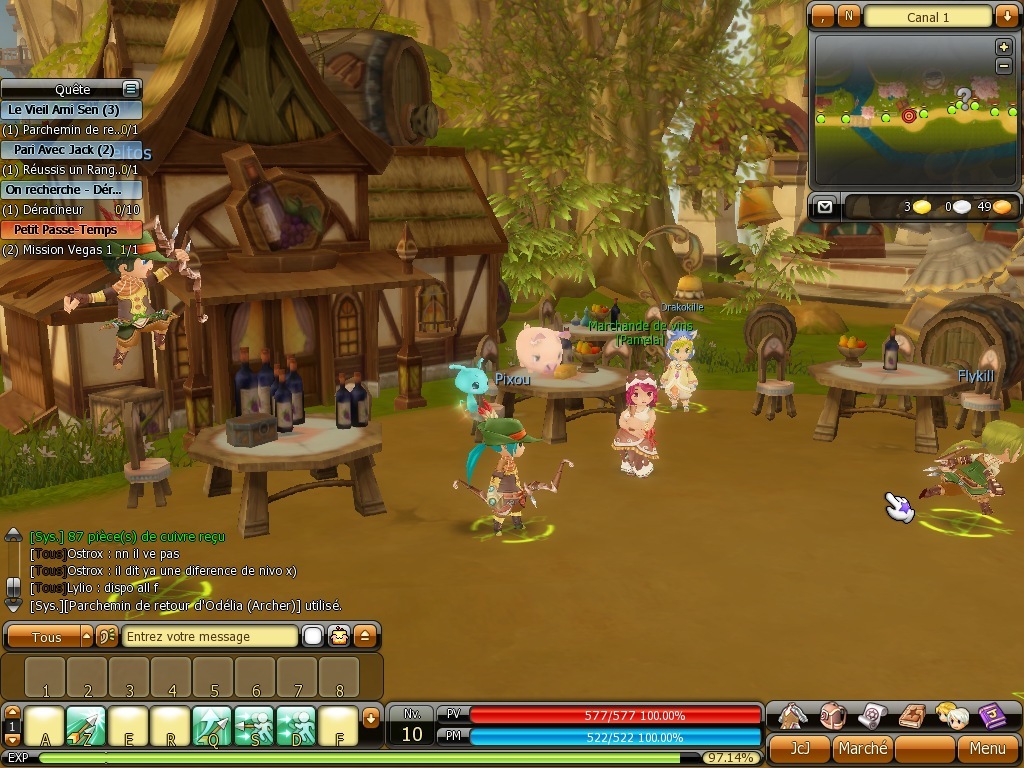
Arcadia, Episode 3 is the final part of the seventh expansion for Dragon Saga. It was released in 2018 on the North American worldwide servers. This expansion completes the main story line started in the vanilla game, with new maps, class balances, events, monsters, dungeons and equipment. Content updates continue on a weekly basis. The final boss, Destiny Dragon proved to be much too challenging in initial releases and has been reworked in subsequent updates. Along with the expansion came a graphical overhaul of the PVP maps and the Arcadia City region. With Arcadia 3 came a change in the overall tone of the logo, login screen and patcher, reflecting the dark and corrupted nature of the Destiny Dragon.
Dragon Saga (7)[edit]
Development is currently underway to create the next expansion.[citation needed]
Development[edit]
ICE Entertainment released Version 6 of the Chinese Dragonica in Open Beta on April 24, 2009.[17] IAH's and 8interactive's Dragonica for the SEA-ANZ region have been live since 2009.[18]gPotato Europe's EU English, French and German services began on June 10, 2009 after a Closed Beta period in the previous month.[19] It has been in full release since the October 2009 release of Tales of the Damned.[20]
THQ*ICE, the former publisher of the North American version, started official service on October 15, 2009. They shut down their service on August 31, 2010, and Gravity Interactive re-launched the North American service[21] in mid-October of that year under the new name Dragon Saga, after purchasing Barunson Interactive, the game's developer.[22]
Nexon, the Korean publishers of the game, announced that their service would shut down in July 2011.[23][needs update]
As of 2013, all development for Dragon Saga had been done in house by Gravity Interactive. Art, story boarding, 3d modeling and server hosting is all done by a dedicated team.
References[edit]
- ^'Dragon Saga (Dragonica) Developer now Gravity Interactive'.
- ^'Warpportal publishing Dragon Saga'.
- ^ ab'Dragonica Introduction Document'. Barunson Interactive. Archived from the original on 30 April 2009. Retrieved 24 April 2009.
- ^'Dragonica Interview with IAHGames'. MMOsite.com. Retrieved 23 April 2009.
- ^'Dragonica enters open beta in Europe - Massively'. Massively. Retrieved 16 September 2009.
- ^'Information on Dragonica Online's Beta Test Phases'. THQ*ICE. Archived from the original on 14 August 2009. Retrieved 13 August 2009.
- ^'gPotato Europe announces the first expansion for Dragonica: Tales of the Damned'. IGN. Retrieved 16 September 2009.
- ^'gPotato Europe announces the second expansion for Dragonica: Awakening of the Ice Dragon'. PC Gamers World. Archived from the original on 15 February 2011. Retrieved 7 May 2011.
- ^'Dragonica - Story Overview / Game Overview & Beta Tests'.
- ^'Dragonica - Game Story'. Archived from the original on 7 October 2011.
- ^[1]
- ^'Dragonica – Paris Strikes Back Expansion Goes Live Today'. MMOFront.
- ^'Archived copy'. Archived from the original on 9 August 2011. Retrieved 25 August 2011.CS1 maint: archived copy as title (link)
- ^'Dragon Saga launches Kyros Unleashed update'. MMOhut. Retrieved 24 July 2011.
- ^[2]
- ^[3], Retrieved 2011-06-08.
- ^'(Dream Dragon) Fire Shadow Version Open Beta today!'. ICE Entertainment. Archived from the original on 27 April 2009. Retrieved 24 April 2009.
- ^'IMPORTANT: CBT Shift and Extension!'. IAHGames. Archived from the original on 26 April 2009. Retrieved 23 April 2009.
- ^'Dragonica goes on public release as Open Beta launches'. gPotato Europe. Archived from the original on 31 July 2009. Retrieved 20 June 2009.
- ^'Dragonica Enters Full Commercial Service with Tales of the Damned Expansion'. IGN.com. Retrieved 13 July 2011.
- ^'Phase 1 Beta Testing in NA'. Gravity Interactive. Retrieved 9 October 2010.
- ^'Gravity to Acquire Controlling Interest in Barunson Interactive'. NBC News. Retrieved 13 July 2011.
- ^'Dragonica Shutting down in Korea next Month'. MMOSite.com. Retrieved 13 July 2011.
External links[edit]
- Official Barunson Interactive website at the Wayback Machine (archived March 11, 2009)
- Author: admin
- Category: Category
| Dragonica | |
|---|---|
| Basic Information | |
| Video Game | |
| Action, FantasyMMORPG | |
| Download | |
| USB Game Pad, Keyboard, Mouse (non-gameplay)[1] | |
| Windows 2000, Windows XP and Windows Vista[2] | |
| Technical Information | |
| Various stages | |
| Awards Changelog Cheats Codes Codex Compatibility Covers Credits DLC Help Localization Manifest Modding Patches Ratings Reviews Screenshots Soundtrack Videos Walkthrough | |
Don't forget to get those Costume Inventory Expansion items while they are on sale in the Dragon Saga Item Mall! Which favored costumes do you have in your Costume Inventory?
Dragonica Online is a 3D action side-scrollingMMORPG (massively multiplayer online role-playing game) developed by Barunson Interactive. Development has been ongoing since March 2006.[2] Operation of Dragonica is relegated to different publishers for their respective regions. It is a free-to-play game which includes a cash shop that allows for unique customization of player's characters.[4] The game has been in Open Beta across Europe since June 10, 2009[5], has implemented the Kundara Content Update during August 2009[6] and has announced that the 'Tales of the Damned' expansion will be introduced during October 2009[7]. The North American Open Beta Test began on August 18, 2009.[8] Characters created during the Open Beta Test will carry over to the commercial release.[9]
Gameplay[editedit source]
Players control a character in a three-dimensional plane but the scope of movement is mainly focused on the horizontal axis with limited vertical movement, much like the arcade style side-scrolling classics. In its current state, players can progress through 65 levels in the North American release with the level cap reaching as high as 80 on servers in Asia.
Combat is action-based with moves performed in real-time. All combat is centered around the use of special skill sets on cooldowns. Players can also perform ground and aerial combos by utilizing certain skills in order to render enemies unable to retaliate but can also play the role of a healer or supporter when necessary.
There is also a large number of missions and scenarios for a player to complete co-operatively with others. Each individual dungeon has one to four separate modes for advancement, each increasing in difficulty and not being accessible until the previous instance has been cleared. At the end of every mission sequence is a scenario that advances your character to the next stage of the game.
Classes[editedit source]
At the beginning of the game, players are allowed to choose from one of four basic classes and accumulate levels in order to advance into deeper specialties with more abilities and skills. Classes include the warrior, thief, archer, and the magician. Each class has a diverse skill tree in which players may place points into to acquire new skills or enhance ones that have already been obtained.
The warrior is a melee-oriented class which focuses mainly on performing various air combos and ground techniques to keep enemies immobilized and weakened. In groups the warrior assumes the role of a 'tank' though not in the conventional sense; the warrior is in charge of keeping enemies from reaching the mid-lines where the healers and ranged classes are ideally situated. Against bosses the warrior will often bear the brunt of the attacks due to the lack of ranged attacks. The warrior class can advance to become either a gladiator or knight.
The thief class employs swift attacks and combos to annihilate waves of enemies. Focused around the use of claws, the thief is often seen on the frontlines alongside the warriors dealing damage and debuffing enemies at will. In group situations, the thief makes use of attacking from behind the enemy in order to increase the ranking score on mission maps. They specialize in and speed to tear down lines of enemies as quickly as possible. Oftentimes they are utilized as 'cleaners' or 'sweepers' in missions to pick up any enemies the frontline may have missed. The thief class can advance to become either a jester or assassin.
The archer class wields bows, crossbows, and even gatling guns to lay waste to any enemies from afar. They are seen mainly in the mid-line in-between the healers and the melee classes. They capitalize on wreaking havoc on enemies by spamming one button to keep the enemy in midair to obtain as high of a ranking as possible in groups. Although their attack power is weaker than that of a warrior's, their attack speed and movement speed is among the fastest in the game. Archers can advance to become either a pathfinder or a arbalist.
The magician is the game's token caster class. Seen very often in the frontlines, the magician is occupied with either healing and buffing the group or dealing massive amounts of area of effect damage to enemies. In groups the magician becomes one of the most valuable assets as they are able to heal the wounds of damaged allies and offer support from a distance, without ever getting caught up in the action itself. Magicians can advance to become either an monk or a battlemage.
Missions[editedit source]
Dragonica features instances that allow players to gain access to items, experience, and currency as well as serve to advance the overall storyline in the game. These instances are known as 'missions' and must be completed sequentially in order to unlock the final scenario that advances the plot. Each step in the mission becomes significantly more difficult than the previous and oftentimes requires a group to complete.
Missions are often composed of four main mission modes (increasing in difficulty) and a fifth scenario (unlocked when the previous modes have been completed). Each step in the mission also features a grading system that attempts to rank players based on how a player has performed during that step. The grading system allows the player to obtain higher quality and quantity loot based on that individual's performance and group contribution.
Players will often be sent into these missions to complete important quests. Although many of these missions can be done by oneself, the benefits of tackling these missions with others far outweigh that of taking them on alone. Players in groups gain bonus experience and, with the right group composition, will find it much easier to progress through the game.
I'll say it again: I'm NOT a troll, and what I just said is NOT a joke. I played the game for at least two hours or so and for some reason, other than the bad camera and occasionally messed-up A.I., but other than that, I just can't find any other problems with the game. Drake of the 99 dragons amazon. I never got stuck in a glitch, the voice acting is actually not too bad, and the fact that Drake (the main character) moves fast is something that I've actually found as a cool feature to the game.
Cash Shop[editedit source]
Cash shop equipments may be soulcrafted and enchanted to increase the stats and defense of the player. Items range from changing your character's standard hairdos to seasonal costumes and attire. Several items from the cash shop include Enchantment Insurance to eliminate the possibility of a loss when enhancing or soulcrafting a character's equipment, or Experience Potions which allow for a character to receive an increase in experience received for the duration in which it is used. More recently, several cash shop items have been included which offer an assortment of random items much like the treasure chests found in Atlantica Online.
Development[editedit source]
ICEE's Chinese Dragonica released their and no but yes Version 6 Open Beta on April 24, 2009.[10] Publisher of the North American version, THQ*ICE, has started the official service on October 15, 2009. As of August 31st, THQ*ICE will be shutting down their services and Gravity Interactive will continue North American publishing in late September.[11]
IAH and 8interactive's Dragonica for the SEA-ANZ region is currently in Open Beta.[12]gPotato Europe's EU English, French and German services began on June 10, 2009.[13]
| Region | Language(s) | Publisher | Alpha | Alpha #2 | Pre-CBT | CBT | OBT | Full Release |
|---|---|---|---|---|---|---|---|---|
| China | Simplified Chinese | ICE Entertainment[14] | March 19–27, 2008[15] | July 2008 | November 6, 2008[16] | February 26, 2009[17] | ||
| Southeast Asia, Australia, New Zealand | English, Simplified Chinese | IAHgames[18] / 8interactive[19] | June 14–15, 2008[20] | July 24–28, 2008[4] | February 13–14 & 20-21, 2009[21] | May 7–18, 2009[12] | June 4, 2009[22] | |
| Taiwan, Hong Kong, Macau | Traditional Chinese | GameFlier[23] | May 25, 2009[24] | |||||
| Europe | English, French, German | gPotato Europe[25] | May 13–22, 2009[26] | June 10, 2009[27] | October 15, 2009[28] | |||
| North America | English | THQ*ICE[29] Gravity Interactive, Inc. (As of August 31, 2010)[30] | March 30 - April 1, 2009 | May 29, 2009[31] | June 30, 2009[32] - July 14, 2009 | August 5, 2009 | October 15, 2009[33] | |
| Korea | Korean | PlayNC[34] | April 17–23, 2008[35] | September 1, 2010 | ||||
| Thailand | Thai | ONENET[36] | December 1–8, 2009 [37] | December 23, 2009 [38] | December 23, 2009 [39] | |||
| Russia | Russian | Nival Group[40] | December 11–21, 2009 [41][42] | December 24, 2009 [43] | ||||
| Japan | Japanese | Nexon Japan[44] | December 23–28, 2009 [45] | January 6, 2010 [46] | January 20, 2010 [47] | |||
| Philippines | English | Egames[48] | December 2009 | April 1 - May 3, 2010 | July 19, 2010 [49] - August 18, 2010 | August 24, 2010 |
References[editedit source]
- ↑Superb quality and action, Dragonica. Barunson Interactive. Retrieved on 2009-04-24
- ↑ 2.02.12.2Dragonica Introduction Document. Barunson Interactive. Retrieved on 2009-04-24
- ↑System Requirements. Barunson Interactive. Retrieved on 2009-04-23
- ↑ 4.04.1Dragonica Interview with IAHGames. MMOsite.com. Retrieved on 2009-04-23
- ↑Dragonica enters open beta in Europe - Massively. Massively. Retrieved on 2009-09-16
- ↑Dragonica Europe: Kundara Dungeon and VanCliff Fortress. OnRPG. Retrieved on 2009-09-16
- ↑gPotato Europe announces the first expansion for Dragonica: Tales of the Damned. IGN. Retrieved on 2009-09-16
- ↑THQ*ICE Dragonica Online Open Beta Test Countdown Page. THQ*ICE. Retrieved on 2009-08-13
- ↑Information on Dragonica Online's Beta Test Phases. THQ*ICE. Retrieved on 2009-08-13
- ↑(Dream Dragon) Fire Shadow Version Open Beta today!. ICE Entertainment. Retrieved on 2009-04-24
- ↑Interview: Draconica THQ*ICE to Close. Barunson Interactive. Retrieved on 2010-8-10
- ↑ 12.012.1IMPORTANT: CBT Shift and Extension!. IAHGames. Retrieved on 2009-04-23
- ↑Dragonica goes on public release as Open Beta launches. gPotato Europe. Retrieved on 2009-06-20
- ↑http://ml.playcool.com/
- ↑Interview: ICEE Dragonica Marketing Manager on China CBT 1. CM Kaye. Retrieved on 2008-11-01
- ↑(China) Dragonica CBT launches on November 6. MMOsite.com. Retrieved on 2009-04-23
- ↑Dragonica enters Open Beta in China!. MMOsite.com. Retrieved on 2009-04-23
- ↑http://dragonica.iahgames.com
- ↑http://dragonica.8i.net.my/
- ↑LATEST UPDATE!!! Focus-Group Revival. CM Kaye. Retrieved on 2009-04-23
- ↑Fall In Love With Dragonica!. CM Kaye. Retrieved on 2009-04-23
- ↑8i Open Beta. 第八互动 梦龙传团队. Retrieved on 2009-05-30
- ↑http://ml.gameflier.com/
- ↑Closed Beta ends but Open Beta announced - May 25th -. gameflier.
- ↑http://dragonica.gpotato.eu/
- ↑- Dragonica Closed Beta Test 13th – 22nd of May -. gPotato Europe. Retrieved on 2009-05-08
- ↑- Closed Beta ends but Open Beta announced - June 10th -. gPotato Europe.
- ↑- Commercial Release - October 15th -. gPotato Europe.
- ↑http://dragonica.thqice.com/
- ↑http://forums.warpportal.com/index.php?/topic/2664-official-announcement-from-barunson-interactive/
- ↑http://dragonica-online.blogspot.com/2009/05/dragonica-online-preview-beta-test.html
- ↑http://dragonica.thqice.com/forum/viewthread.php?tid=1230&page=1
- ↑-Dragonica Online Grand Opening: October 15th. Retrieved on 2009-10-12
- ↑http://dragon.plaync.co.kr/
- ↑Dragonica proceeds Closed Beta Test on April 17. Barunson Interactive. Retrieved on 2009-04-23
- ↑- Dragonica Thailand.
- ↑- Thai Closed Beta.
- ↑- Thai Open Beta.
- ↑- Thai Official launch.
- ↑- Nival Group signs liecense for Russian dragonica.
- ↑- Russian Closed Beta Start.
- ↑- Russian Closed Beta end.
- ↑- Russian Open Beta Start.
- ↑- Dragonica Japan.
- ↑- Japanese Closed Beta.
- ↑- Japanese Open Beta.
- ↑- Japanese Official launch.
- ↑- Dragonica Ph.
- ↑- Ph Close Beta.
External links[editedit source]
- Dragonica Fan Wiki on Wiki.com
| Dragon Saga | |
|---|---|
| Developer(s) | Gravity Interactive[1] |
| Publisher(s) | gPotato Europe, GSquare, Nexon, Warpportal[2] |
| Engine | Gamebryo[3] |
| Platform(s) | Microsoft Windows |
| Release | Full list, see below |
| Genre(s) | Massively multiplayer online role-playing game |
| Mode(s) | Multiplayer |
Dragon Saga (Korean: 드래고니카) called Dragonica pre-2010, is a free-to-play3Dside-scrollingmassively multiplayer online role-playing game developed by Barunson Interactive and Gravity Interactive. Development has been ongoing since March 2006.[3] Operation of Dragon Saga is relegated to different publishers for their respective regions. Whilst being free-to-play, the game also includes a cash shop that allows for unique customization of player's characters.[4] The game's commercial launch was on June 2009 in China and October 2009 in Europe and October 2010 in North America.[5] Characters created during the Open Beta testing were carried over to the commercial release.[6]
Six content expansions for the game have been released, all of which are free: Tales of the Damned which was released on 16 October 2009[7] and Awakening of the Ice Dragon which was released on 15 February 2011[8] have both been released in North America.
Plot[edit]
Dragon Saga takes place on the continents of El Grego and Angrakka (Elyades and Melanthos in Europe), which had experienced a golden age where humans and dragons were able to live together in peace. These times were not destined to last, and the dragons and humans eventually went to war in what was known as the Dragon Age. Eventually, the dragons were banished to the ancient realm of Aether. The leader of the dragons, Dark Dragon Elga, would continue to mount attacks, but was pushed back when five heroes of legend defeated and trapped him in a prison known as the Shadow Cabinet.
Not even the Shadow Cabinet could hold Elga forever — a thousand years after being trapped, Elga found a method to release his darkness into the world, sending minions to attack the lands in preparation for his arrival. It is up the players to take up arms and push back these dark forces.[9][10]
Gameplay[edit]
Players control a character in a three-dimensional plane but the scope of movement is mainly focused on the horizontal axis with limited vertical movement, much like the arcade style side-scrolling classics. In its current state, players can progress through 75 levels in the North American release with the level cap reaching as high as 80 on servers in Asia.
Combat is action-based with moves performed in real-time. All combat is centered around the use of special skill sets on cooldowns. Players can also perform ground and aerial combos by utilizing certain skills in order to render enemies unable to retaliate but can also play the role of a healer or supporter when necessary.
There is also a large number of missions and scenarios for a player to complete co-operatively with others. Each individual dungeon has one to four separate modes for advancement, each increasing in difficulty and not being accessible until the previous instance has been cleared. At the end of every mission sequence is a scenario that advances your character to the next stage of the game.
Classes[edit]
At the beginning of the game, players are allowed to choose from one of six basic classes and accumulate levels in order to advance into deeper specialties with more abilities and skills. The six starting classes are warrior, thief, archer, magician, summoner, and twin fighter. Each class has a diverse skill tree in which players may place points into to acquire new skills or enhance ones that have already been obtained. As of 15 February 2011, there are currently a total of four class advancements in the game bringing the total number of playable classes to 28.
Tasks[edit]
Dragon Saga features instances that allow players to gain access to items, experience, and currency as well as serve to advance the overall storyline in the game. These instances are known as 'missions' and must be completed sequentially in order to unlock the final scenario that advances the plot. Each step in the mission becomes significantly more difficult than the previous and oftentimes requires a group to complete.
Missions are often composed of four main mission modes (increasing in difficulty) and a fifth scenario (unlocked when the previous modes have been completed). Each step in the mission also features a grading system that attempts to rank players based on how a player has performed during that step. The grading system allows the player to obtain higher quality and quantity loot based on that individual's performance and group contribution.
Players will often be sent into these missions to complete important quests, such as those needed to change class. Although many of these missions can be done by oneself, the benefits of tackling these missions with others far outweigh that of taking them on alone. Players in groups gain bonus experience and, with the right group composition, will find it much easier to progress through the game.
Expansions[edit]
Tales of the Damned (1)[edit]
Tales of the Damned was published on 16 October 2009 in Europe and November 2010 in North America. Tales of the Damned added a variety of new content and features to the game. This included the addition of a new storyline, controller support and the introduction of pets. The expansion elaborated into the story of the first chapter and as a result two new areas in Dragotaka were also introduced accessible to those who are level 60 or above only; the Van Cliff Dungeon and Drakos' Tower, which served as a fortified tower used to imprison the evil Dragon Lord Elga, until the witch Paris broke in and freed him to cause mayhem across the land. In addition to these new maps, Tales of the Damned also raised the level cap from 60 to 65.[11]
Paris Strikes Back (2)[edit]
Paris Strikes Back was the second expansion to Dragon Saga and was released only in Europe on 23 June 2010.[12] This expansion included the next chapter of the storyline, increased the level cap from 60 to 70 and has other general enhancements such as new weapon and armour sets. Some maps were also given a nice tune-up including the Van Cliff Dungeon and Drakos' Tower, both of which were given the choice of three levels of difficulty. Also, eight new classes were added to the game: Dragoon, Berserker, Sentinel, Bombardier, Joker, Shadow Walker, Cleric and Chaosmage. All the new classes were named by the Dragon Saga forum community but are only accessible after the player hits level 60 and a chain quest is completed.[13]
Dragon Saga Kryos Unleashed (Dragon Saga Awakening of the Ice Dragon) (3)[edit]
Awakening of the Ice Dragon (known as Kryos Unleashed in North America)[14] was the third expansion to Dragon Saga. It was released on 15 February 2011 in Europe and North America. The expansion includes the brand new ice continent of Pagosia in which the third chapter of the story is set. As the name suggests, large portions of Pagosia are entombed in ice, with its frosty appearance enhanced by the spooky spectral creatures that live in its fresh landscape. Seasoned heroes, from level 62 upwards, will find a large quantity of new maps in Pagosia, filled with new sets of both hero and daily quests, providing more than enough challenges for players. The expansion also increased the level cap again, this time to level 75. All the classes introduced in Paris Strikes Back were also made available in the North American version of this expansion.[15]
Dragon Saga Elga Unleashed (Dragon Saga New Origin) (4-1)[edit]
Elga Unleashed (also known as New Origin) is the fourth expansion for Dragon Saga.[16] It was released on 8 June 2011 in the Japanese server, 10 August 2011 on the SEA server and 12 September 2011 on the European Servers. The expansion includes a new playable race that has 2 new classes. These 2 classes are the summoner and the twin fighter. The fourth chapter to the story is added and as a result the world map has had a complete overhaul due to the influence of chaos in the world of Dragotaka. The level cap has been raised to 80. The second phase of the Elga Unleashed expansion known as Elemental Guardians introduces new content including two new dungeons.
Dragon Saga Worlds Collide (4-2)[edit]
Worlds Collide was a major event for Dragon Saga. It involved an in game crossover event between Dragon Saga and Ragnarok Online which was exclusive to the WarpPortal North America release. This mini-expansion opens a new series of quests and dungeons with a unique top down camera angle. Costumes, pets, mounts and weapons from Ragnarok Online are available through the quests and merchants near the dungeon entrances.
Dragon Saga Galaxia (5)[edit]
Galaxia is the fifth official expansion for Dragon Saga. It was released in 2013 on the North American worldwide servers. The expansion follows the player as they help Crete save her lover, the god Pios, from the chaos of the corrupted Zodiac! This includes new class abilities, quest lines, 10 new zodiac themed dungeons with 4 difficulty levels, an increased level cap (lvl 85) for players.
Dragon Saga Arcadia, Episode 1 (6-1)[edit]
Arcadia, Episode 1 is the sixthofficial expansion for Dragon Saga. It was released in 2016 on the North American worldwide servers. This expansion explores new lands and cities of Arcadia; a land of elemental power. Players can discover hidden dungeons and defeat powerful elementals, dragons, and monsters while crafting powerful elemental weapons and armors. This expansion includes new class abilities, quest lines, pets and mounts, costumes and weapons, new socketing systems, and new elemental stat progressions.
Dragon Saga Arcadia, Episode 2 (6-2)[edit]
Arcadia, Episode 2 is the second part of the seventh expansion for Dragon Saga. It was released in 2017 on the North American worldwide servers. This expansion builds on the previous update, with new maps, class balances, events, monsters, dungeons and equipment. Content updates continue on a weekly basis.
Dragon Saga Arcadia, Episode 3 (6-3)[edit]
Arcadia, Episode 3 is the final part of the seventh expansion for Dragon Saga. It was released in 2018 on the North American worldwide servers. This expansion completes the main story line started in the vanilla game, with new maps, class balances, events, monsters, dungeons and equipment. Content updates continue on a weekly basis. The final boss, Destiny Dragon proved to be much too challenging in initial releases and has been reworked in subsequent updates. Along with the expansion came a graphical overhaul of the PVP maps and the Arcadia City region. With Arcadia 3 came a change in the overall tone of the logo, login screen and patcher, reflecting the dark and corrupted nature of the Destiny Dragon.
Dragon Saga (7)[edit]
Development is currently underway to create the next expansion.[citation needed]
Development[edit]
ICE Entertainment released Version 6 of the Chinese Dragonica in Open Beta on April 24, 2009.[17] IAH's and 8interactive's Dragonica for the SEA-ANZ region have been live since 2009.[18]gPotato Europe's EU English, French and German services began on June 10, 2009 after a Closed Beta period in the previous month.[19] It has been in full release since the October 2009 release of Tales of the Damned.[20]
THQ*ICE, the former publisher of the North American version, started official service on October 15, 2009. They shut down their service on August 31, 2010, and Gravity Interactive re-launched the North American service[21] in mid-October of that year under the new name Dragon Saga, after purchasing Barunson Interactive, the game's developer.[22]
Nexon, the Korean publishers of the game, announced that their service would shut down in July 2011.[23][needs update]
As of 2013, all development for Dragon Saga had been done in house by Gravity Interactive. Art, story boarding, 3d modeling and server hosting is all done by a dedicated team.
References[edit]
- ^'Dragon Saga (Dragonica) Developer now Gravity Interactive'.
- ^'Warpportal publishing Dragon Saga'.
- ^ ab'Dragonica Introduction Document'. Barunson Interactive. Archived from the original on 30 April 2009. Retrieved 24 April 2009.
- ^'Dragonica Interview with IAHGames'. MMOsite.com. Retrieved 23 April 2009.
- ^'Dragonica enters open beta in Europe - Massively'. Massively. Retrieved 16 September 2009.
- ^'Information on Dragonica Online's Beta Test Phases'. THQ*ICE. Archived from the original on 14 August 2009. Retrieved 13 August 2009.
- ^'gPotato Europe announces the first expansion for Dragonica: Tales of the Damned'. IGN. Retrieved 16 September 2009.
- ^'gPotato Europe announces the second expansion for Dragonica: Awakening of the Ice Dragon'. PC Gamers World. Archived from the original on 15 February 2011. Retrieved 7 May 2011.
- ^'Dragonica - Story Overview / Game Overview & Beta Tests'.
- ^'Dragonica - Game Story'. Archived from the original on 7 October 2011.
- ^[1]
- ^'Dragonica – Paris Strikes Back Expansion Goes Live Today'. MMOFront.
- ^'Archived copy'. Archived from the original on 9 August 2011. Retrieved 25 August 2011.CS1 maint: archived copy as title (link)
- ^'Dragon Saga launches Kyros Unleashed update'. MMOhut. Retrieved 24 July 2011.
- ^[2]
- ^[3], Retrieved 2011-06-08.
- ^'(Dream Dragon) Fire Shadow Version Open Beta today!'. ICE Entertainment. Archived from the original on 27 April 2009. Retrieved 24 April 2009.
- ^'IMPORTANT: CBT Shift and Extension!'. IAHGames. Archived from the original on 26 April 2009. Retrieved 23 April 2009.
- ^'Dragonica goes on public release as Open Beta launches'. gPotato Europe. Archived from the original on 31 July 2009. Retrieved 20 June 2009.
- ^'Dragonica Enters Full Commercial Service with Tales of the Damned Expansion'. IGN.com. Retrieved 13 July 2011.
- ^'Phase 1 Beta Testing in NA'. Gravity Interactive. Retrieved 9 October 2010.
- ^'Gravity to Acquire Controlling Interest in Barunson Interactive'. NBC News. Retrieved 13 July 2011.
- ^'Dragonica Shutting down in Korea next Month'. MMOSite.com. Retrieved 13 July 2011.
External links[edit]
- Official Barunson Interactive website at the Wayback Machine (archived March 11, 2009)